Is Your Corrugated Equipment Costing You More Than You Think?
Older corrugated equipment can still be extremely productive.
A flexo folder gluer, rotary die cutter, printer-slotter, corrugator, feeder, stacker, or converting line may have years of useful life remaining if the frame and core mechanical structure are sound.
The real problem is often not the machine itself.
It is outdated controls, obsolete drives, worn mechanical components, slow setup times, registration problems, recurring electrical faults, excessive scrap, and unplanned downtime.
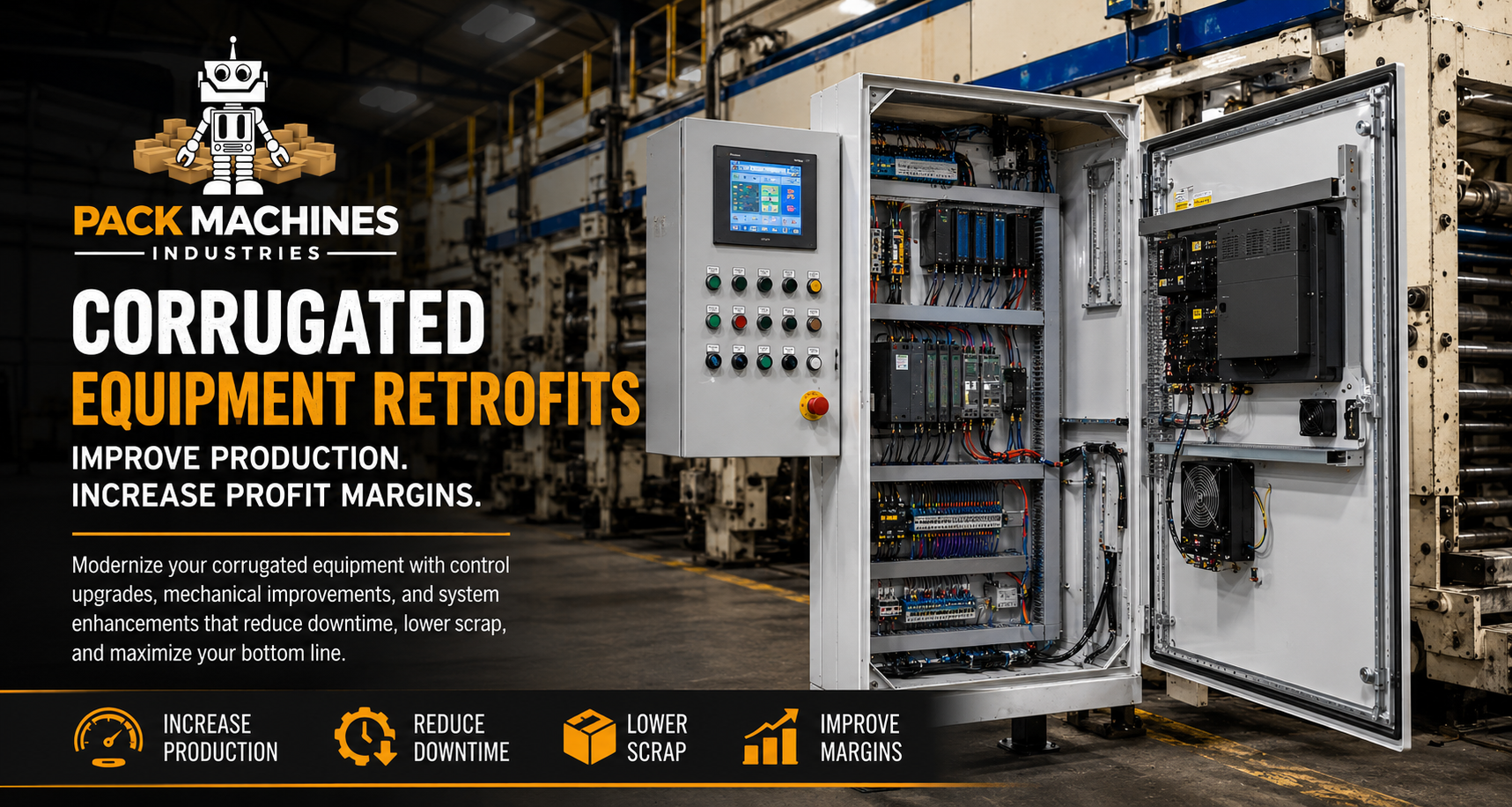
A properly engineered corrugated equipment retrofit can help increase production, reduce downtime, lower waste, improve reliability, and strengthen profit margins.
Before investing in a completely new machine, it may be worth asking a different question:
How much money is the equipment you already own capable of making with the right upgrades?
Downtime Directly Reduces Profit
Every minute a machine is stopped is production that cannot be sold.
The true cost of downtime can include:
- Lost production
- Idle operators
- Overtime
- Emergency maintenance
- Expedited parts
- Missed delivery dates
- Production scheduling problems
- Reduced plant capacity
- Lost opportunities to accept additional work
A machine does not need to be completely broken to cost a plant money.
A flexo folder gluer that stops repeatedly, requires constant operator adjustments, or cannot maintain its intended production speed may be quietly reducing profitability every shift.
If that problem continues for months or years, the accumulated cost can become far greater than the cost of correcting the machine.
Higher Production Can Mean Better Margins
The plant that produces more sellable boxes per labor hour generally has a lower manufacturing cost per box.
Consider two machines producing the same product.
One runs with:
- Fast setups
- Accurate registration
- Minimal downtime
- Low scrap
- Reliable feeding
- Consistent production speeds
The other experiences:
- Frequent faults
- Slow changeovers
- Manual adjustments
- Registration problems
- Excessive scrap
- Mechanical wear
- Repeated production stops
The selling price of the finished box may be similar, but the manufacturing cost is not.
That is why production efficiency matters.
More sellable production + less downtime + lower waste = stronger profit margins.
A retrofit is not simply a maintenance expense.
When properly planned, it can be an investment in production capacity.
Scrap Is Money Going Into the Waste System
Scrap is one of the biggest hidden costs in corrugated manufacturing.
Every rejected sheet already contains expenses.
You have already paid for:
- Paper
- Ink
- Adhesive
- Labor
- Electricity
- Machine time
- Material handling
Poor registration, worn rollers, damaged scoring components, inconsistent feeding, mechanical movement, or outdated controls can all contribute to waste.
The goal of a retrofit should not simply be to make a machine run faster.
The goal should be to increase the number of sellable sheets and boxes produced per hour.
Even a modest reduction in scrap can create meaningful annual savings in a high-volume plant.
Faster Setups Create Additional Capacity
Changeovers can consume a major portion of available production time.
Older equipment may require operators to spend excessive time adjusting:
- Print sections
- Slotting sections
- Scoring positions
- Die-cut registration
- Folder rails
- Glue systems
- Feeders
- Stackers
Modern controls, positioning systems, drives, and automation can improve setup speed and repeatability.
Saving five or ten minutes on one setup may not sound significant.
Multiply those savings across multiple orders, shifts, weeks, and months.
That can become hundreds of additional production hours every year.
Those hours can allow a plant to produce more orders without adding another shift or buying another machine.
Obsolete PLCs and Controls Create Production Risk
Many older corrugated machines are mechanically strong but still operate with unsupported electronics.
Common obsolete components include:
- PLC processors
- Drives
- Touchscreens
- Operator computers
- Servo controls
- Circuit boards
- Encoders
- Sensors
- Proprietary control modules
When one critical component fails, the machine may remain down while a replacement is located, repaired, or redesigned.
A planned PLC retrofit or controls modernization can reduce that risk.
Waiting until the system fails completely can turn a planned project into an emergency.
Emergency repairs usually mean greater downtime, more disruption, and higher costs.
A Retrofit Should Address the Entire Machine
Installing a new PLC will not repair a worn shaft.
A new touchscreen will not correct poor alignment.
New drives will not solve damaged bearings or excessive mechanical movement.
A successful retrofit may require both electrical and mechanical improvements.
Depending on the equipment, upgrades may include:
- PLC and HMI modernization
- Servo and drive upgrades
- Electrical cabinet rebuilding
- Motor replacement
- Registration improvements
- Feeder modernization
- Vacuum transfer improvements
- Printing section repairs
- Rotary die cutter rebuilding
- Scoring and slotting improvements
- Folder-gluer upgrades
- Stacker and counter-ejector upgrades
- Bearing and shaft replacement
- Gear and roller rebuilding
- Sensors and encoder replacement
- Machine alignment and leveling
- Anchoring and grouting
- Foundation and concrete work
The entire machine has to work together.
Your Operators Should Not Have to Fight the Machine
Experienced operators often learn to compensate for equipment problems.
They know which sensor needs adjustment.
They know which section has to be manually repositioned.
They know which fault appears every day.
They know how fast the machine can run before it starts creating problems.
Over time, these workarounds become normal.
They should not be.
Your operators should be focused on quality and production, not constantly compensating for worn components or outdated technology.
If your best operators are spending too much time keeping the machine running, your plant is losing efficiency.
The Cost of Doing Nothing
Plant managers often evaluate modernization by asking:
How much will the retrofit cost?
That is important, but there is another question that should be asked:
How much is the machine costing us every month because we have not upgraded it?
The cost of waiting can appear through:
- Lost production
- Excessive downtime
- High scrap rates
- Emergency repairs
- Slow changeovers
- Overtime
- Higher labor cost per box
- Obsolete replacement parts
- Missed deliveries
- Reduced capacity
- Lost customers
- Lost opportunities
Postponing a retrofit does not necessarily mean you are saving money.
You may simply be paying for the problem every day through lost efficiency.
Retrofit or Replace the Machine?
There are situations where purchasing new corrugated equipment is the right decision.
However, replacing a machine can involve much more than the purchase price.
A new production line may require:
- Long manufacturing lead times
- Freight
- Rigging
- Foundations
- Electrical infrastructure
- Installation
- Commissioning
- Operator training
- Production disruption
For many plants, retrofitting a structurally sound machine can provide a strong alternative.
The right decision depends on the mechanical condition of the equipment, current production losses, parts availability, future production requirements, and the expected return on investment.
Pack Machines Corrugated Equipment Retrofit Services
Pack Machines provides complete corrugated machinery services, including:
- Corrugated equipment retrofits
- PLC modernization
- Electrical controls upgrades
- Mechanical rebuilding
- Troubleshooting
- Equipment dismantling
- Match-marking
- Rigging
- Millwright services
- Equipment relocation
- Machine installation
- Laser leveling and alignment
- Anchoring and grouting
- Concrete foundations
- Commissioning and startup
- Plant relocations
- Complete equipment removal
- Buying and selling corrugated equipment
Because we work with the entire machine, we can evaluate mechanical, electrical, structural, and production issues together.
How Much Production Is Your Machine Leaving on the Table?
Before spending heavily to replace an older corrugated machine, determine whether it can be upgraded.
A properly engineered retrofit may help provide:
- Higher production speeds
- More sellable boxes per hour
- Reduced downtime
- Lower scrap
- Faster setups
- Better registration
- Improved reliability
- Easier troubleshooting
- Longer equipment life
- Increased plant capacity
- Improved profit margins
The steel and structure of your machine may still have years of life remaining.
The technology and components surrounding it may simply need to be brought up to date.
Contact Pack Machines
If your flexo folder gluer, rotary die cutter, printer-slotter, corrugator, feeder, stacker, or other corrugated equipment is suffering from downtime, obsolete controls, slow production, excessive scrap, or repeated maintenance problems, Pack Machines can evaluate potential retrofit options.
Before spending millions replacing a machine, find out what the machine you already own is capable of producing.
Pack Machines
Engineering • Corrugated Equipment Retrofits • Rigging • Millwright • Installation • Rebuilding • Relocation • Concrete & Foundations • Equipment Sales